
- Services
- Accounting and Tax automation
-
-
InvoiceProxy

Seamlessly switch from paper to electronic
We offer you the experience of fully data-driven electronic invoicing, with the security of the infrastructure provided by the National Tax and Customs Administration (NAV).
More…
-
TaxConsole
Automate your Invoices with TaxConsole
Our TaxConsole application allows access to NAV’s digital services directly from your computer.
More…
-
-
- Accounting and Tax automation



In our experience, in 2020, both auditors and the tax authority put more emphasis on the auditing of transfer pricing between affiliates, as well as the end-of-year correction items and the existence of transfer pricing documentations, and a similar approach is also expected for 2021.
In case certain transactions between affiliated enterprises are not properly documented, the tax authority may impose a default penalty, in which case the amount of the fine may be up to HUF 2 million (EUR 5,500) per transaction, and in case of improper pricing, they may also correct the tax base and impose further fines.
Taxpayers concerned must prepare the master file and the country (local) file, and above a certain price also the country-by-country report (CbCR). The deadline for the preparation of the local (country) file is the same as the deadline for filing the corporate income tax returns.
At the same time, many companies use transfer pricing corrections at the end of the year, in case of which problems may easily arise, and therefore, we recommend very careful treatment of this issue and, in a given case, also the involvement of an expert. It is worth thinking over the following:
- was the extent of the targeted and the achieved profit sufficient?
- is the transfer pricing policy created by the group also adequate in Hungary, do the rules established comply with the local requirements?
- are all recognized expenses properly supported?
- is the accounting and tax law treatment of the end-of-year correction items suitable, and are the tax base reducing items properly justifiable?
- are there any difficulties with the timely documentation of the transaction and the use of the proper method of supporting the transfer pricing used?
Our experts typically encounter the following, frequently occurring problems and deficiencies:
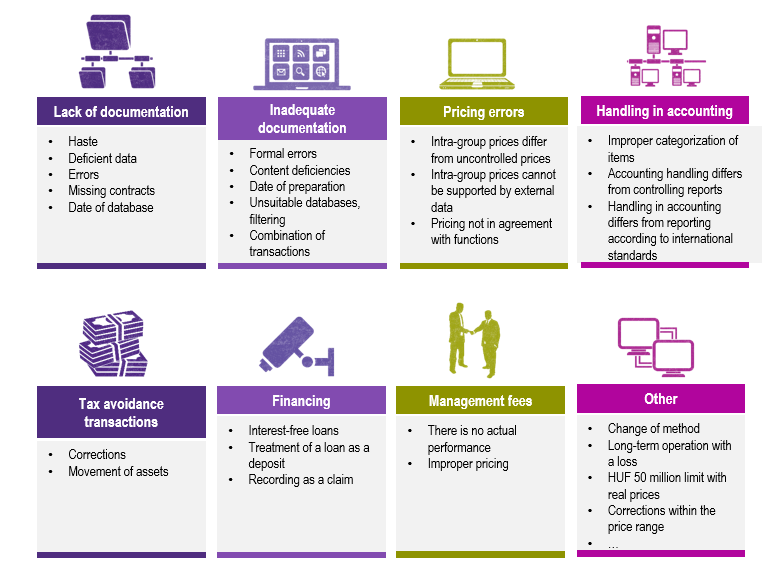
We do hope that we could be at your service with this information. Should you have any further queries, please feel free, to contact us!
On 1 December 2020, the Hungarian Parliament passed yet another tax-related bill, the purpose of which is to provide assistance to families in the creation of housing. The bill introduces a 5% rate of VAT for the sale of certain new residential properties, and also waives the property transfer tax for those receiving the family housing benefit (CSOK).
VAT
From 1 January 2021, the following will (once again) subject to 5% VAT:
- “new” condominium units with a total useful floor space of 150 square metres or less; and
- “new” single-unit residential properties (detached houses) with a total useful floor space of 300 square metres or less.
In the system of VAT, a property is to be considered as “new” if an occupancy permit has not yet been issued, or it was issued within the past 2 years.
The 5% VAT rate is temporary, and as a principal rule, it is applicable until 31 December 2022. However, under the transitory rules, the favourable VAT rate is still applicable for transactions completed between 1 January 2023 and 31 December 2026, provided that:
- the construction permit has become final by 31 December 2022; or
- the fact of the construction has been notified under the rules of the simplified notification procedure by 31 December 2022.
Property transfer tax
From 1 January 2021, the amended law provides a full exemption from the property transfer tax for the purchase of new or used residential properties in the framework of the family housing benefit (CSOK) scheme, independently from the market value of the property. The new provision can be applied to contracts dated after 1 January 2021. It is important to note that in case of advanced CSOK benefit, if the childbirth undertaken is not realized (with the exception of health-related reasons), or the subsidized loan is repaid before its maturity (e.g. due to a divorce), then the property transfer tax must be paid after all.
We do hope that we could be at your service with this information. Should you have any further queries, please feel free, to contact us!
Dear Sir/Madam,
We cordially invite you to our webinar “Tax Grants and R&D reliefs in Automotive Industry – CEE Countries” on December 2, 2020 between 14:00 and 15:30.
Our Grant Thornton automotive experts in six countries will take you through the current tax subsidy landscape for the automotive industry in selected Central and Eastern European countries.
You will be given an overview of tax relief on wages and salaries, deductible business expenses, special relief for R&D, and learn about the ability to carry forward or carry back losses.
Our countries and their respective experts:
Germany: Mr. Thomas Lämmer-Gamp, Head of Strategy Advisor Automotiveland NRW
Germany: Mr. Paul Forst, WP/StB I Partner I Head of Tax
Austria: Mr. Christoph Schmidl, Mag. I Partner I Head of BPS
Poland: Mrs. Malgorzata Samborska, Partner I Head of Tax Advisory
Slovakia: Mr. Wilfried Serles, StB I Managing Partner
Czech Republic: Mr. Petr Nemec, Partner I Tax
Hungary: Mrs. Timea Zednik, Director I Tax
Moderation: Mr. Andrew Dickson
The webinar is free of charge and will be held in English.
Take advantage of the opportunity to get fully up to date with the current tax opportunities for organizations in the automotive sector and to discuss with our country experts.
Login or add it to your calendar: http://newsletter.wkgt.com/m/12350306
We are looking forward to welcome you to the webinar!
We do hope that we could be at your service with this information. Should you have any further queries, please feel free, to contact us!
Amendments applicable to teleworking are finally out
On 11 November 2020, Government Decree 487/2020 (XI.11.) on the Application of Teleworking Rules During the State of Danger was promulgated, providing derogations from the provisions of the Occupational Health and Safety Act (Act XCIII of 1993) and the Labour Code (Act I of 2012), and allowing employers to provide teleworking opportunities in a lawful manner.
The #stayathome campaign launched in March 2020 launched, on a large scale, the possibility commonly referred to as “home office”, with the help of which many people were able to continue their work from home. The best option for this would have been the application of “teleworking”, as defined in the Labour Code:
“activities performed on a regular basis at a place other than the employer’s facilities, using computers and other means of information technology, where the end product is delivered by way of electronic means.” [Section 196 (1) of Act I of 2012]
The large number of employees working from home, however, shed light on the legislative shortcomings, whereby the Labour Code and the Occupational Health and Safety Act does not provide clear rules, or sometimes even provisions that are contradictory or cannot be applied in practice.
With the second wave of the Coronavirus, lawmakers sought to remedy this situation.
Occupational Health and Safety Act
The Government Decree mentions occupational health and safety measures in two sections: (Section 1).
- During the state of danger currently in effect, Section 86/A of the Occupational Safety and Health shall not apply.
This means that during the state of danger, the occupational safety rules also normally applicable for teleworking do not apply.
In other words, the following may be dispensed with in case of teleworking:
- an agreement with the employer to provide the employee with a means of teleworking;
- the employer’s risk assessment of the safety of such means of work;
- the employer’s consent to the employee changing the working conditions applicable to teleworking;
- conducting a risk and accident safety audit by an occupational safety and health professional, as well as the on-site inspection of the working conditions by the employer’s representative.
- The Government Decree also stipulates that in the case of teleworking, the employer must inform the employees concerning the rules of non-hazardous and safe working conditions necessary for working, and the employees must choose the place of work subject to the fulfilment of these working conditions.
Personal Income Tax Act
The Government Decree provides that, from the amount paid to the employees working in the framework of teleworking arrangements pursuant to the provisions of the employment contract as a reimbursement for the expenses incurred in connection with teleworking, the amount agreed upon between the parties in advance but not exceeding 10 percent of the prevailing minimum wage (which is HUF 161,000 in 2020) may be considered as eligible expenses without documentation, provided that the employee did not claim any other expenses in connection with teleworking.
Importantly, this reimbursement amount (HUF 16,100 / month) must be reduced time-proportionately for the number of teleworking days in case the employee did not work in teleworking arrangements in the entire month.
Labour Code
The Government Decree seeks to support the current use of teleworking in a single paragraph. During the state of danger, the employee and the employer may deviate from Section 196 of Act I of 2012 on the Labour Code by means of an agreement. (Section 3)
The abovementioned section of the Labour Code contains the primary rules for teleworking.
This means that the parties may deviate from the following rules in a separate agreement:
- Teleworking is an activity performed on a regular basis at a place other than the employer’s facilities, using computers and other means of information technology, where the end product is delivered by way of electronic means.
- In the employment contract the parties shall agree on the worker’s employment by means of teleworking.
This part is particularly important because the obligation to set forth this agreement in the employment contract is a much more momentous act of labour law between the parties. At the present time, this can be dispensed with, and it is sufficient for the parties to conclude a separate agreement.
- Beyond the obligations set forth in Section 46 of the Labour Code, the employer must also inform the employee of the following:
- inspections conducted by the employer;
- any restrictions as to the use of computing equipment or electronic devices; and
- the department to which the employee’s work is in fact connected.
- The employer must provide the teleworker with all the information that it otherwise provides to other employees.
- The employer must allow the employee to enter its premises and to keep in touch with other employees.
In the current interpretation of the legislation, it is important to underline the fact that in the part on the application of the PIT Act, the Government Decree specifically mentions that the reimbursement of expenses may be paid in case of teleworking pursuant to the provisions of the employment contract, while the part on the application of the Labour Code allows the parties to dispense with the amendment of the employment contract.
For this reason, it is important to pay attention to the fact that those who work in a teleworking arrangement only on the basis of an agreement, without amending the employment contract, cannot claim a reimbursement of expenses theoretically.
However, since an agreement on teleworking is also based on the joint intention of the parties, it may be worth amending the employment contract after all, even if only for a specific, fixed period only. In this way, the reimbursement of expenses can also be claimed.
If you have any further questions regarding the above, please contact our colleague directly.
We do hope that we could be at your service with this information. Should you have any further queries, please feel free, to contact us!
The Parliament of Hungary passed bill no. T/13258, the autumn tax package, into law. In the current issue of our newsletter, we provide a summary of the amendments in the tax package, as well as discuss the most important changes. Please do not hesitate to contact our experts if you have any questions concerning the details, the entry into force, or the transitory rules. The Parliament also continues to discuss further amendments of tax-related laws; we will inform you once these are passed.
Value-added tax (VAT)
The amendment transposed into Hungarian law the European Union’s rules on e-commerce (webshop sales) entering into force from 1 July 2021. These amendments encompass four broad areas, as part of which:
- the rules of intra-Community distance sales will change;
- the VAT-exemption of small-value import consignment will be abolished;
- online marketplaces facilitating e-commerce will be taxed, and
- the amendment also introduces a recording obligation in connection with the above (as defined in Council Implementing Regulation No 282/2011, and adopts a one-stop-shop system for the fulfilment of the new types of tax liabilities.
In case of forming, ending, joining or leaving a VAT group, taxpayers can specify from what future date they wish the change to be effective.
The amendment also creates the possibility for the tax base to be reduced subsequently in connection with bad debts (irrecoverable claims) if the buyer is not a subject of VAT. The conditions applicable to VAT subjects are also applicable in this case, with the exception that it is not necessary to give advance notice to buyers that are not a subject of VAT in advance concerning the intention to reduce the tax base. A transitory provision in connection with the above is that – in case the conditions are satisfied – the VAT of irrecoverable claims against non-VAT subject buyers can be reclaimed also in case of transactions performed before 1 January 2021, but after 31 December 2015.
Further changes:
- the elapse of one year after the tax due date is not a condition of the tax base reduction if the period of limitation under civil law is less than one year (e.g. subscription contracts under the Act on Electronic Communications);
- such claims will also be considered as irrecoverable from the payment of which the debtor is relieved in the course of a debt settlement procedure of natural persons (personal insolvency).
The rules applicable in case of the cancellation of VAT number will change in terms of the right to deduct taxes. If the VAT number of the tax subject is reinstated by the tax authority upon application, the right of tax deduction will remain in place also during the period when the VAT number was cancelled. Under the current rules, the tax deduction right ends upon the cancellation becoming final.
In contrast with the earlier plans, the domestic reverse charge mechanism related to temporary staffing will continue to apply. If, however, the derogation is not extended by the EU despite Hungary’s request, then the reverse charge mechanism will be limited to temporary staffing in the construction industry only.
From 1 July 2021, the amendment will permit the National Tax and Customs Administration (NAV) to prepare the taxpayer’s VAT return proposal (eVAT) on the basis of the data received by NAV. In the framework of the above, from the 12th day after each tax period, the tax authority will make available to the tax subject information on the amount of the tax base and the payable amount of the tax, based on the records of the tax authority for the given period, as well as the amount of the tax base and the tax charged to the tax subject. This VAT return proposal may be supplemented, amended and accepted on the online interface introduced for this purpose. The acceptance of the VAT return proposal will also include the submission of the domestic summary report. Taxpayers for which the frequency of VAT returns changes after July 2021 (e.g. required to file monthly returns as opposed to quarterly returns before) may only use the option of VAT return proposals after 1 January 2022. It is important to note that the use of the VAT return proposal is not mandatory. Taxpayers may continue to fulfil their VAT return filing obligations as before, with the use of the forms designated for this purpose.
The amendment of the law extends the scope of the data that need to be submitted to the tax authority when issuing invoices. Therefore, from 4 January 2021, the following will also be required information within the data supply obligation:
- the currency of the invoice, and in case of foreign currency, the exchange rate used for conversion;
- in case of free-of-charge transactions that qualify as the supply of goods or services under the VAT Act, the fact that the transaction was free of charge, as well as an indication as to whether the buyer of the goods or services is required to pay the VAT shown on the invoice;
- in case of invoices of transactions performed outside the territorial scope of the Hungarian VAT Act, an indication of this fact.
Corporate income tax
In case of businesses or permanent establishments in countries in the EU’s blacklist of non-cooperative tax jurisdictions, the exceptions – from the point of view of related tax-base increasing items – linked to the thresholds applicable to controlled foreign companies are not applicable. Tax base reducing items related to controlled foreign companies will change in the interest of ensuring that incomes derived from genuine transactions can be tax free.
When examining the activities of foreign persons in Hungary, some additional aspects will also have to be taken into consideration to determine whether the foreign person is considered to have a permanent establishment in Hungary. A foreign company will be considered to have a permanent establishment also in case it provides a service by way of a natural person in the employment or in some other legal relationship with it, if the duration of the provision of service exceeds 183 days in any 12-month period. In addition, a foreign person will also be considered to have a permanent establishment in Hungary if its activity satisfies the criteria for permanent establishments as defined in the treaty for the avoidance of double taxation.
The rules applicable to the tax allowances related to investments and renovations serving energy-efficiency purposes will change unfavourably for taxpayers. Under the new rules, the tax allowance cannot be used for the purchase of passenger cars (including electric cars), with the exception of such special motor vehicles that may, by reason of their configuration, be converted for the transportation of goods. This limitation is applicable in case of investments and renovations started after the new rules enter into effect.
The limitation of HUF 10 billion applicable to the development reserve will be eliminated, which means that this tax base reducing item can be used up to the total amount of the pre-tax profit.
With a view to the amendment of the Accounting Act, the use of tax base modifying items related to the cancellation of dividends (according to which the payer of dividends could reduce the tax base by the income due to the cancellation of dividends, or the member did not have to increase its tax base by the expense incurred as a result of such cancellation) will be abolished.
In connection with the limitation of interest deductions, the amendment changes the proportion of the group-level tax base increasing obligation that can be taken into consideration for the individual group members. In the future, the proportionate part of the non-deductible, net financing cost must be taken into consideration in the individual tax bases.
Support for spectator sports teams may also be provided for expenses incurred in direct connection with the protection against the coronavirus pandemic, as well as the safety measures prescribed by the national federation of the given sport.
Personal income tax
From 2021, there will be a change in the method whereby the personal allowance available from the personal income tax can be used. So far, taxpayers diagnosed with certain illnesses, which are listed in a separate government decree, have been able to reduce the amount of the personal income tax payable after their combined tax base by the amount equalling to 5% of the prevailing minimum wage. Under the new rules, the allowance can be deducted not from the payable tax, but from the combined tax base. The extent of the tax base allowance will be one third of the prevailing minimum wage for each month of entitlement (rounded to a figure dividable by HUF 100), and therefore, the amount with which the tax burden can be reduced is the same as under the previous personal allowance scheme. This allowance can be enforced before the allowance for first-time married couples and the family tax allowance.
From the promulgation date of the act, vaccinations and pandemic screening examinations will be tax free. (Earlier, only vaccinations were listed among tax free items.)
From 2021, the combined value limit of benefits provided via “SZÉP” (cafeteria benefits) cards – up to which amounts it is considered as a non-wage benefit – will be HUF 450 thousand, regardless of whether the payer is a publicly financed body or some other type of employer.
On the basis of another, previously promulgated amendment, with a view to the coronavirus pandemic, the exemption of non-wage benefits paid to SZÉP cards from the social contribution tax had been extended by six months, until 30 June 2021.
Small business tax (“KIVA”)
The limits in terms of revenue and balance sheet total set as opt-in criteria for KIVA have been increased from the earlier HUF 1 billion to HUF 3 billion. At the same time, the earlier limit of HUF 3 billion above which companies could no longer pay their taxes under the KIVA scheme was increased to HUF 6 billion.
Another favourable change related to disqualifying from KIVA was that in case the net amount of taxes owed by a tax subject exceeded HUF 1 million, it automatically meant the end of their KIVA taxpayer status. In the future, the tax authority may revoke its decision ending KIVA taxpayer status if the taxpayer settles its tax liability before the decision becomes final.
Further, certain rules applicable to tax objects switching from KIVA to corporate income tax have also been amended.
Itemised tax of small businesses (“KATA”)
The stricter rules applicable to KATA taxpayers from January have been further clarified. With a view to the fact that, in case of foreign customers, the 40% extra tax is payable not by the customer but by the KATA taxpayer, in such cases only 71.42% of the income will be considered as the tax base.
Local business tax (LBT)
Some new provisions are being promulgated in connection with arm’s length prices used between affiliated parties (under the relevant provisions of the Act on the Rules of Taxation, arm’s length prices have already had to be used when determining the base of the LBT). The reduction of the net sales revenue, or taking into consideration items reducing the net sales revenue is only possible when determining the amount of the LBT due, if the taxpayer has a declaration from the other party to the effect that it has increased its own LBT base or its corresponding foreign tax base (such as its business tax, corporate tax or equivalent tax base) by the abovementioned corrections.
The concept of temporary business activity, as consequently also the tax payable after such activity, will be eliminated. In line with this change, the definition of permanent establishments for the purposes of LBT will be supplemented by such places where building construction activities are continued over a period exceeding 180 days.
Due to the change in the definition of permanent establishment and the elimination of the concept of temporary business activity, the special tax base division method used by businesses pursuing building construction activities will also change. A further change in connection with the asset-proportionate division of the tax base is that the value of leased motor vehicles is to be taken into consideration in proportion to the personnel expenses allocated to the given registered seat or business premises.
The act also settles the question of how to handle errors according to the Accounting Act in tax returns. Under the new rules, if a business carries out a self-revision with a view to an error of significant or non-significant amount, or the tax authority conducts an audit and the error discovered is found to have an effect on the LBT base, then the correction of the error must also be taken into account in the LBT base for the tax year in which the error was discovered. It is important to note that the taxpayer may also decide to take the effect of the error into consideration of the tax assessment for the tax year of discovery, and not perform self-revisions for the previous tax year(s).
The method to file LBT returns is also going to change. In the future, the tax returns may be submitted to the central (state) tax administration only, with only private individuals who are not sole traders allowed to file their tax returns to the local tax authority.
In the future, the forms related to the local tax authorities will be uniform, and the local authorities may only supplement the data notifications and the tourism tax returns, with a view to the allowances provided by way of local decrees. Businesses that do not apply an exemption may also satisfy their notification obligations by filing the forms published on the website of the ministry to the individual local authorities.
Motor vehicle tax
Tax authority tasks related to motor vehicle tax will be transferred from local authorities to the central tax administration. Due to this transition, the motor vehicle tax payment obligation for the first half of 2021 is to be performed by 15 April 2021.
The special tax of credit institutions
The amendment clarifies that the special tax of credit institutions paid during the pandemic situation will, by way of tax withholding, reduce the special tax of financial institutions in the next 5 years, up to the extent of 20% of the tax for 2020 in each year.
Tourism development contribution
Restaurant and accommodation services provided as intermediated services, for which the VAT is 5%, are not subject to the tourism development contribution.
Procedural fees
With a few remaining exceptions, the amendment abolishes the obligation to pay procedural fees for the starting of first-instance administrative authority proceedings. This will be done by way of reorganizing the earlier system of the Act on Duties and Fees in such a way that Schedule 1 to the Act will list the procedures subject to fees, and Schedule 2 will list the exempted procedures. The proceedings launched by businesses requesting payment facilities and tax reductions, as well as the proceedings of specialized authorities, will also be exempted from procedural fees.
The rules of taxation
Pursuant to the supplemented provisions on the status of taxpayers, when designating a tax group as having reliable taxpayer status, it is not necessary to take into consideration newly joining group members that have not existed for 3 years. This provision is to be first applied to statuses assigned after the fourth quarter of 2020.
From January 1, 2021
- the ban of payment facilities will be extended to corporate income tax groups;
- the current automatic granting of paying tax liabilities in instalments over 12 months once a year in case of reliable taxpayers will be changed in such a way that the maximum tax liability is increased from HUF 1.5 million to HUF 3 million;
- natural persons will be able to apply for the option to pay in 12 monthly instalments in case of tax liabilities up to HUF 1 million instead of the earlier HUF 500 thousand;
- the provision favouring reliable taxpayers by way of imposing reduced tax fines will be eliminated, which means that in the future the amount of the tax fine that may be imposed – also in case of reliable taxpayers – will be 50%, or in more serious cases up to 200%, of the tax arrears.
A further change is that, in certain cases, the prohibition of aggravation cannot be applied, and the amendment also introduces restrictions in terms of the admissibility of new facts and circumstances in case of applications for supervisory measures. These rules are to be applied in proceedings launched after 1 January 2021, as well as in repeated proceedings.
From 1 July 2021, the institution of extended conditional tax assessment will be abolished.
DAC 6
Under the amended rules, when there are several participants in a transaction that are subject to the reporting obligation, all of them are required to use a joint identifier in their reports, which will be generated by the tax authority on the basis of the party first submitting its report. The amendment provides that this identifier is to be shared with the other participants in the transaction.
Accounting
The amendment clarifies that in case of capital increase by share premium, the accounting date for recording the change in the capital reserve must be same as the accounting date of the change in the related subscribed capital.
A new event will be added to the list of legal titles under which the profit reserve may change, according to which cancelled dividends must be recorded as an increase of the profit reserve at the time of the cancellation.
Among other items of the profit and loss statement, the profit achieved on the assignment of claims and on the sale of intangible and tangible assets will have to be shown as net amounts, similarly to the IFRS.
There will be an additional possible legal title for generating tied-up reserves, which is the tax liability of legal successors arising in connection with company transformations.
Companies whose securities are traded on the regulated market of any of the states of the European Economic Area will be required to publish their annual reports by the last day of the fourth month following the balance sheet date.
We do hope that we could be at your service with this information. Should you have any further queries, please feel free, to contact us!
The new rules of health and economic protection published
Tuesday night, Act CIX of 2020, along with a government decree introducing new restrictions and measures entering into effect from 12 am on 11 November 2020, were published in the official gazette Magyar Közlöny; on the basis of the promulgated text of the decree, it is effective until 11 December 2020.
On the basis of the official text of the of the decree, the following is a brief summary of the new restrictions:
- A curfew is introduced between 8 pm and 5 am, which means that everyone must return to their address of residence by 8 o’clock in the evening. People may be exempted from the curfew for work-related reasons; however, these reasons must be properly documented.
- All gatherings of people is prohibited.
- Restaurants cannot allow guests to enter, with the exception of picking up food prepared for take-away. The Government reduces the administrative burdens of home delivery, and makes taxi operators available for the performance of these tasks. Workplace canteens may continue to be open.
- With the exception of pharmacies and petrol stations, all shop must close at 7 pm, and may next reopen on the following day after the end of the curfew, i.e. not earlier than 5 am. Service providers and services not specifically mentioned in the decree (e.g. hairdressers, massage saloons, personal trainers) may continue to operate according to their normal schedule, while observing the rules of the curfew.
- Hotels may not provide accommodation for tourists, only for guests arriving for business, economic or educational purposes.
- The holding of all kinds of events – including cultural events and Christmas fairs – is prohibited. The ceremonies of religious communities may be held in accordance with the decision of the given religious community. The Government asks religious communities to determine their rules of conduct applicable during their events in accordance with the general rules.
- Sporting events may only be held behind closed doors, without spectators.
- Individual outdoor sports may be exercised. On the basis of the relevant provisions of law, professional athletes cannot be restricted in their activities as such.
- The use of leisure time facilities is prohibited, including in particular fitness centres, indoor swimming pools, museums, libraries, cinemas, zoos and skating rinks.
- Nurseries, kindergartens and primary schools up to the 8th grade continue to be open according to their normal schedules; specific protective measures are to be determined by their directors/principals on the level of the institution. In secondary education, school operate in a digital work format from the 9th grade. Student dormitories for secondary school students may operate subject to the decision of school principals.
- Universities and colleges switch to a digital work format. The dormitories of higher education institutions are generally closed, exceptions may be made by the rector. Students who may be allowed to remain in dormitories are, in particular, international students, students of Hungarian nationality from other countries, as well as those quarantined in the dormitory.
- Private and family events (e.g. birthdays) may be held with the participation of up to 10 people.
- Burials/memorial services may be held with a maximum of 50 people in attendance.
- Weddings (but no wedding parties/receptions) may be held, but only with the participation of a certain set of people as determined.
- Employees at hospitals, schools, kindergartens, creches and social welfare facilities must be tested weekly, in accordance with the provisions of a separate government decree.
- The rules of social distancing and wearing masks earlier introduced remain in effect with the addition that the wearing of masks in certain public areas on settlements with populations over 10,000 people is mandatory. It is the tasks of the mayors to designate such areas.
- The wearing of masks while exercising/engaging in sport, in parks and green areas is still not mandatory.
On the basis of the above, it can be seen that from the point of view of employment, the restrictions affect the following:
- the activities and operations of employers
- the records kept by employers
- the scheduling of working time, work organisation
- in connection with the curfew, the preparation of declarations and other documents related to commuting to and from work
- documents of employment law and the issuing of instructions, as related to the organisation of work
- changes in employment relations (for example, in case of students, possible also the termination of their employment).
The new provisions of law, specifically Government Decree 485/2020. (XI. 10.), also sets forth further measures for the protection of the economy:
On the basis of the new rules, payers who have the following principal business activities, as defined on the basis of the TEÁOR activity codes, may be exempted from the payment of
- the social contribution tax,
- the vocational training contribution tax,
- the rehabilitation contribution tax after their employees,
- as well as from the small business tax base in case of companies that elected to pay the small business tax (KIVA).
The Government Decree lists the following principal activities as exempted from the above:
Section 5. The tax exemptions listed in Sections 1 to 4 are available to taxpayers engaged in the following as their actual, principal business activities:
- Restaurants and mobile food service activities (TEÁOR 5610)
- Event catering activities (TEÁOR 5621)
- Beverage serving activities (TEÁOR 5630)
- Film screenings activities (TEÁOR 5914)
- Organisation of conventions and trade shows (TEÁOR 8230)
- Sports and recreation education (TEÁOR 8551)
- Performing art activities (TEÁOR 9001)
- Support activities to performing arts (TEÁOR 9002)
- Operation of arts facilities (TEÁOR 9004)
- Activities of museums (TEÁOR 9102)
- Operation of botanical and zoological gardens and nature reserves (TEÁOR 9104)
- Operation of sports facilities (TEÁOR 9311)
- Activities of sports clubs (TEÁOR 9312)
- Fitness facilities (TEÁOR 9313)
- Other sports activities (TEÁOR 9319)
- Activities of amusement parks and theme parks (TEÁOR 9321)
- Physical well-being activities (TEÁOR 9604) or
- Amusement and recreation activities not elsewhere classified (TEÁOR 9329).
The promulgated Act of Parliament and the related Government Decrees contain further, detailed rules, exceptions, as well as rules applicable to the implementation of these provisions of law.
If you may also be affected by these changes, do not hesitate to contact our designated colleague.
We do hope that we could be at your service with this information. Should you have any further queries, please feel free, to contact us!